
Nickel-Based Catalysts
Nickel catalysts are among the most widely used in industry. They are relatively inexpensive, highly active, and available in various forms for different applications.
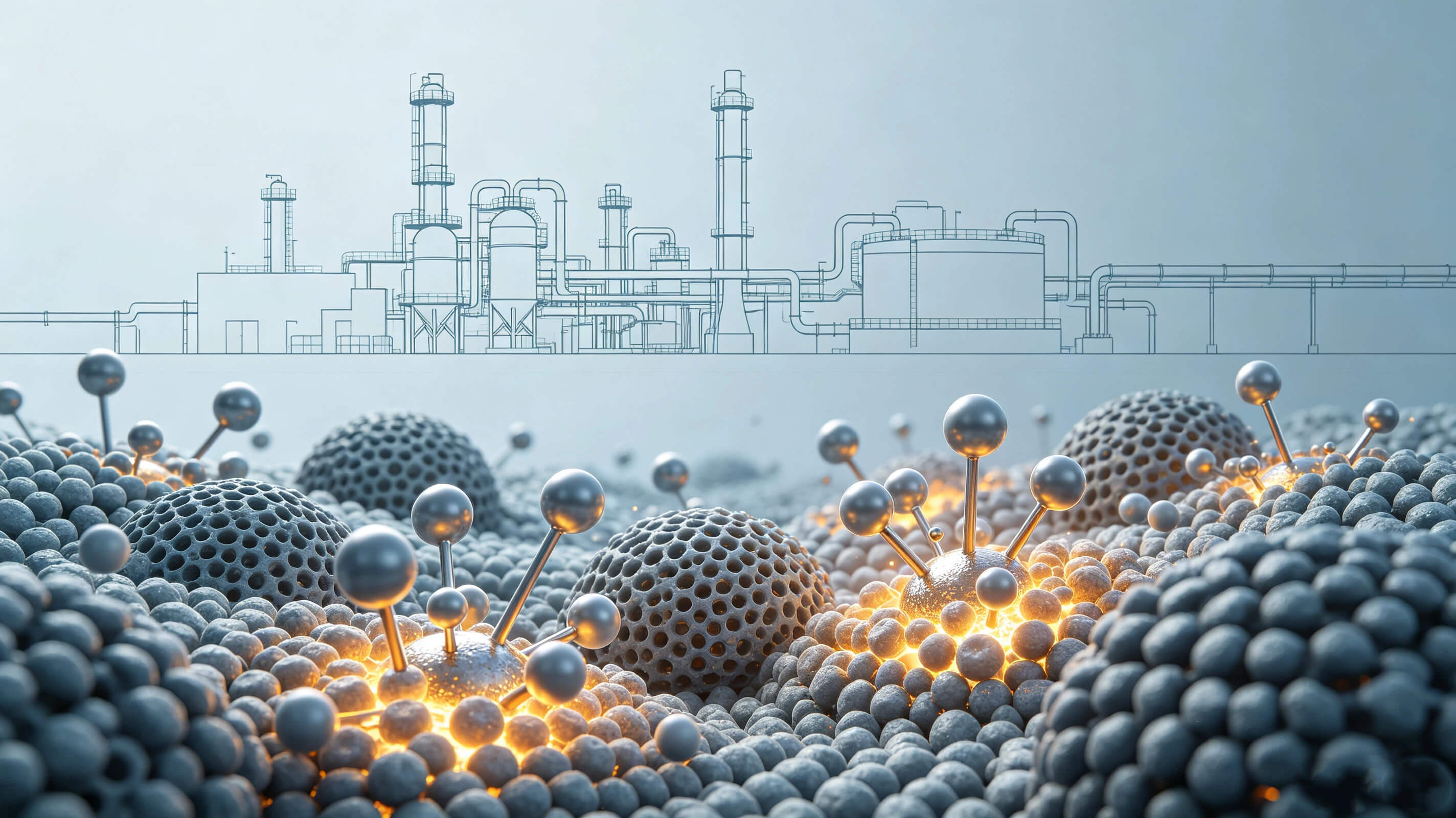
The most common type is Raney nickel, a finely divided nickel-aluminum alloy that has been treated with caustic soda to dissolve most of the aluminum. The result is a porous material with an enormous surface area, typically 100 m²/g. Raney nickel is used extensively for the hydrogenation of vegetable oils, the production of fatty alcohols, and various fine chemical syntheses. It is a mature, well-understood catalyst with decades of industrial service.
For fixed-bed processes, supported nickel catalysts are more common. The nickel is dispersed on a carrier like alumina or silica. The choice of support affects the catalyst's activity, stability, and resistance to poisons like sulfur. High-nickel-content catalysts (typically 40-60 wt%) are used for demanding applications like the hydrogenation of aromatics, while lower loadings serve for selective hydrogenations.
Sulfur tolerance is the primary limitation of nickel catalysts. Even trace amounts of sulfur compounds can deactivate them. For applications where the feed contains sulfur, specialized formulations are available, but in general, nickel catalysts are best suited for clean feedstocks.
Copper-Zinc-Aluminum Catalysts
The Cu/ZnO/Al₂O₃ catalyst is the standard for methanol synthesis and the low-temperature water-gas shift reaction. It has been the industry benchmark since the 1960s.
The copper provides the active sites for hydrogen activation and CO/CO₂ adsorption. The zinc oxide acts as a promoter, enhancing copper's activity through strong metal-support interactions. The alumina serves as a structural stabilizer, keeping copper particles small and well-dispersed. The three components together form a robust system that maintains its activity for years under proper operating conditions.
These catalysts operate at relatively mild temperatures, typically 200-300°C, and moderate pressures (50-100 bar). They are sensitive to high temperatures—above 300°C, copper particles start to sinter and lose activity. Sulfur and chlorine are poisons, so feed purification is essential.
In addition to methanol synthesis, Cu/ZnO/Al₂O₃ catalysts are used for the water-gas shift reaction at low temperatures, converting CO and water into CO₂ and additional hydrogen. They are also used in the production of higher alcohols from synthesis gas and various selective hydrogenations.
Practical Considerations
Both catalyst families require careful handling. Reduction is the first step after loading fresh catalyst. The metal oxides must be converted to their active metallic form using hydrogen. This step must be done slowly and with precise temperature control to avoid overheating.
Deactivation is gradual and inevitable. Nickel catalysts primarily deactivate through sulfur poisoning and carbon deposition. Copper catalysts are more prone to thermal sintering and poisoning by chlorine or sulfur compounds. Regeneration is possible in some cases, but if the deactivation is due to irreversible poisoning, replacement is the only option.
Summary
Nickel-based and copper-zinc-aluminum catalysts are the workhorses of industrial hydrogenation. Nickel catalysts, in their Raney and supported forms, handle a wide range of hydrogenation tasks from oil hardening to fine chemical synthesis. Copper-zinc-aluminum catalysts are indispensable for methanol production and the water-gas shift reaction. Both families are mature, cost-effective, and well-understood—the kind of catalysts that run reliably for years in plants around the world.