
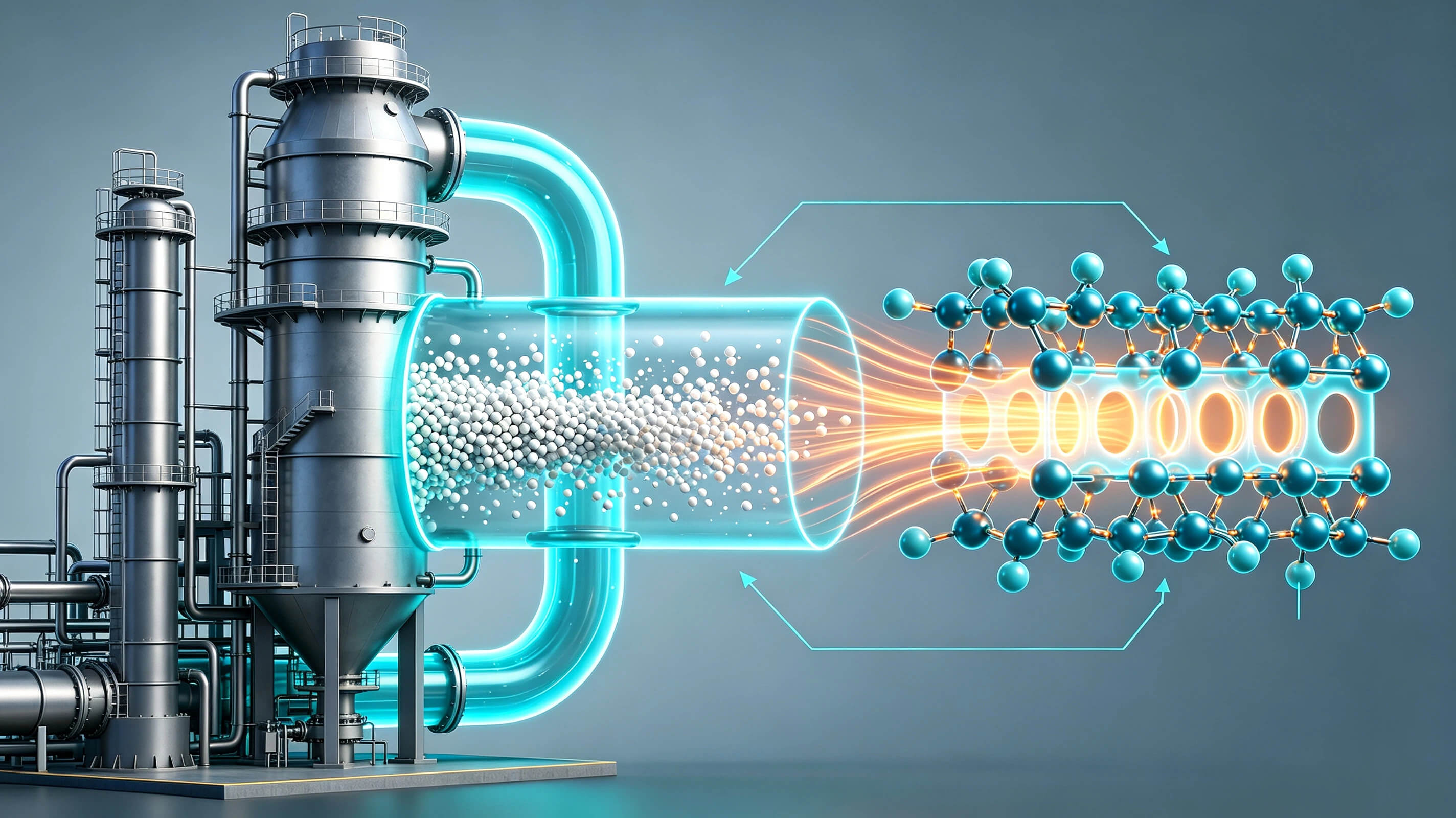
Propylene
is one of the most important building blocks in the petrochemical industry. It
feeds the production of polypropylene, acrylonitrile, propylene oxide, and a
wide range of other chemicals. For years, the majority of propylene came as a
byproduct of ethylene production in steam crackers. But as demand for propylene
has outpaced ethylene growth, refiners have turned to another source: the fluid
catalytic cracking (FCC) unit. Today, FCC units account for a substantial share
of global propylene supply, and that share continues to grow.
The
key to unlocking more propylene from an FCC unit is a small but powerful
additive: ZSM-5 zeolite in microsphere form.
Why
ZSM-5 Works Differently from Y Zeolite
In
a conventional FCC unit, the main active component is Y-type zeolite. Its large
pores, around 0.74 nanometers, allow it to crack heavy gas oil molecules into
gasoline-range products. ZSM-5, by contrast, has medium pores of approximately
0.55 nanometers, formed by ten-membered oxygen rings. This smaller pore size
gives ZSM-5 a different role entirely.
Because
its pores are too small for heavy gas oil molecules to enter, ZSM-5 does not
crack the primary feed. Instead, it targets the gasoline-range olefins that Y
zeolite has already produced. These lighter molecules—particularly C5 to C9
olefins—can enter ZSM-5's channels and undergo further cracking into propylene
and butylene.
ZSM-5
also exhibits what is called transition-state shape selectivity. The
intersections of its pore channels do not form large cavities. As a result,
bulky transition-state complexes that would lead to bimolecular reactions, such
as hydrogen transfer, cannot form. This means ZSM-5 has very low hydrogen
transfer activity, which is precisely what you want when the goal is to
preserve olefins rather than saturate them into paraffins.
The
practical outcome is straightforward: adding ZSM-5 to the FCC catalyst
inventory increases propylene yield at the expense of gasoline. Butylene also
increases, and a small amount of ethylene is produced. As an added benefit, the
gasoline that remains has a higher octane number because ZSM-5 removes
low-octane olefins from the gasoline pool.
The
Microsphere Form: Engineered for the FCC Environment
ZSM-5
is not used as a pure powder in the FCC unit. It is formulated into microspheres that match the physical properties of the main Y-zeolite catalyst. Particle
size distribution, apparent bulk density, and attrition resistance all need to
be compatible, because the additive circulates through the reactor and
regenerator alongside the main catalyst.
A
typical ZSM-5 additive microsphere contains 25 to 50 weight percent ZSM-5
zeolite, with the balance made up of a matrix—usually kaolin clay and a binder
such as alumina or silica. The slurry is spray-dried into microspheres with a
median particle size in the range of 70 to 85 micrometers, matching the FCC
catalyst inventory. The product is a free-flowing white powder with good
attrition resistance, typically below 2 percent per hour by the roller method.
Improving
Performance through Phosphorus Modification
Raw
ZSM-5 loses a significant portion of its cracking activity after exposure to
the high-temperature steam environment of the FCC regenerator. To combat this,
manufacturers treat the zeolite with phosphorus compounds. Phosphorus
modification stabilizes the zeolite framework, reduces dealumination during
hydrothermal aging, and preserves more acid sites for cracking.
The
effect is measurable. In one comparison, a ZSM-5 additive containing phosphorus
and alpha-alumina achieved equivalent attrition resistance to a commercial
additive while containing significantly more ZSM-5 zeolite, translating to
higher propylene yield per unit of additive. The phosphorus content in
commercial additives typically ranges from 3 to 15 weight percent, expressed as
P₂O₅.
How
Refiners Use ZSM-5 Additives
The
additive is blended into the FCC catalyst inventory at levels ranging from a
few percent up to 10 percent or more, depending on the desired propylene
uplift. Unlike a wholesale catalyst replacement, adding ZSM-5 is a flexible,
incremental adjustment. Refiners can increase or decrease the additive dosage
as market conditions change—ramping up propylene production when chemical
margins are strong, and reducing it when gasoline demand is higher.
The
activity of the additive depends not just on the ZSM-5 content but also on the
chemistry used to stabilize the zeolite. Two additives with similar crystal
content can perform very differently in the FCC unit, depending on the
phosphorus treatment, the matrix composition, and the preparation method. This
is why additive selection often requires pilot testing with the specific feed
and unit configuration.
The
Shift toward “More Chemicals, Less Fuel”
The
growing use of ZSM-5 additives reflects a broader shift in refining. Demand for
transportation fuels is plateauing in many regions, while demand for
petrochemical feedstocks continues to rise. FCC units that were designed purely
to make gasoline are being re-tuned to produce more propylene and other light
olefins. ZSM-5 additives are the primary tool for making that transition
without replacing the entire catalyst system or rebuilding the unit.