
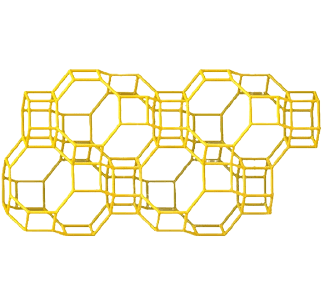
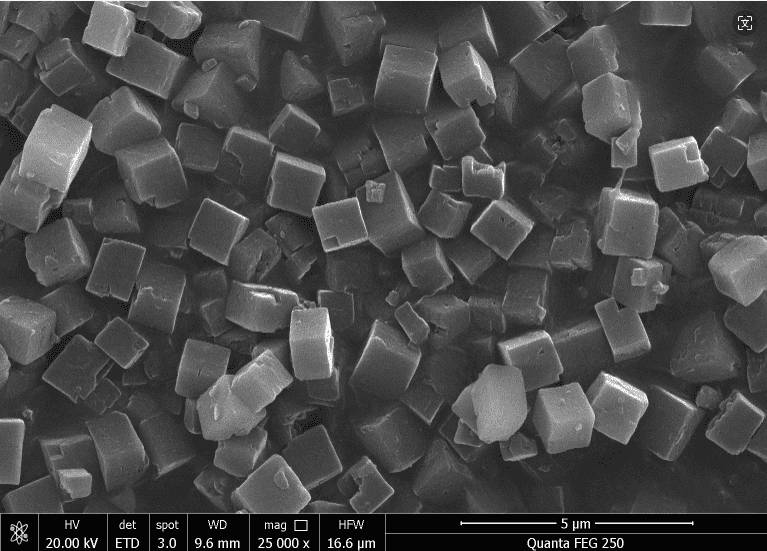
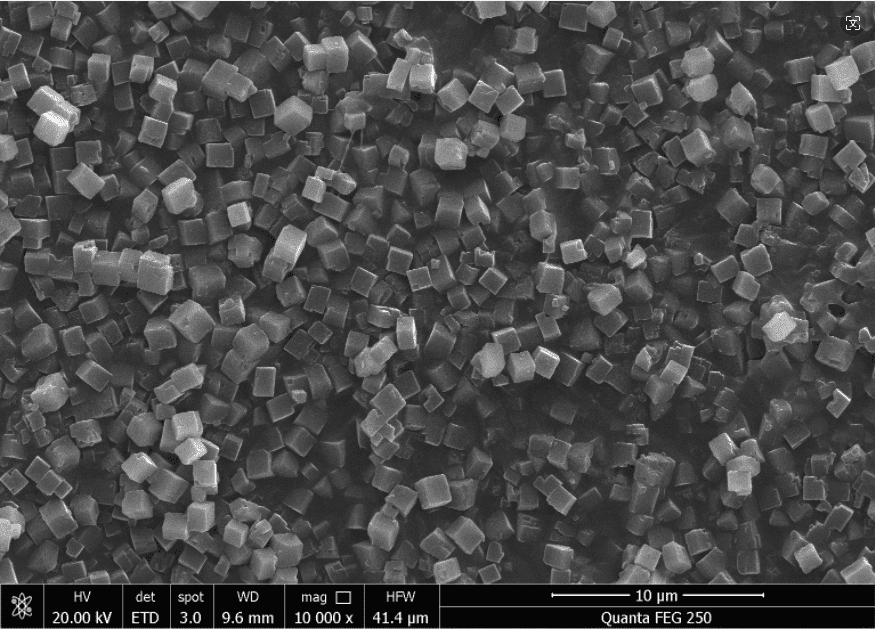
SAPO molecular sieves is a series of novel silicoaluminophosphate that were successfully synthesized by the Union Carbide Corporation In 1982. Since then silicoaluminophosphate molecular sieve and its heteroatom-substituted derivatives have been researched for catalysts. Among these molecular sieves, silicoaluminophosphate SAPO-34 is a molecular sieve with chabazite-type framework containing 8-member ring ellipsoidal cage and 3-dimensional channel, which is formed by stacking of double six-rings according to ABC sequence. SAPO-34 is microporous molecular sieve with a pore size of 0.38×0.38 nm and cage size of 1.0×0.67 nm. Space group of SAPO-34 is R3m belonging to trigonal crystal system.
Due to its proper acidity and pore structure, it has a special water absorbing capacity and bronsted acidity, and This can be used as an adsorbent‚ catalyst and catalyst support in applications with low carbon olefin transfer‚ auto gas purification‚ MTO reactions‚ etc
SAPO-34, CHA Frame Work Type Advanced Zeolite Material
Application
1 Cracking reaction of high carbon hydrocarbons Olefine carcking to product propylene .
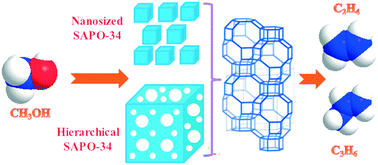
2 Conversion of low- Carbon materials to low -carbon olefin catalytic preparation of low carbon olefin/propylene from methanol
3 Removal of NOX from diesel vehicle exhaust
4 Alkane conversion to produce low carbon olefin Ethane oxidation dehydrogenation propane dehydrogenation